
Sunday, April 5, 2009

Grand Theft in the Garden of Eden

A man walked into my bar last night, and ordered up a beer, a shot o' Jack t' side he said, and you better make it double

So I served him up his drinks and went back to polish glasses—thinking that his eyes they looked like trouble—

like a sky, deep blue with ashes blown 'cross the field between the day and gloaming.

He grinned a grin like a Cheshire moon, but It never touched his eyes, his eyes was sorely jaded, like those on a morning drinker, full of pain and faded hues

He drank his drinks one-two-three, ordered up another round, hummed a line of blues, then said to me:


I'm gonna smoke a cigarette, and I know it's against the law, so call the cops if you want my friend, but if you do I'll break your jaw.

but listen to me well he said, and I'll tip you double, and if you've got an ashtray too, then join me in a smoke, and we wont have any trouble.

I'll buy you drinks all night my friend and tell you about the joke that has me drinking to stop me thinking about the lie that made me who I am.

No one else was in the place, so I thought what the hell, pulled a stool o'er the bar and said to him

I'll set and smoke a spell my friend, and listen to your story—as long as you buy the drinks my friend—

the night was getting boring.

I poured an ale, and had a shot o' the good ol' Irish, then I lit a smoke and he said to me.

My name is Adam, friend he said it's long since I been fit company for either mice or men.


Long ago and far away he said, in the garden o' Eden, I had myself a wife and a friend and she was even fair indeed.

She t'was the best that's ever been, the mother of humanity, I can tell you so, 'cause I was there he said and my friend who was Odin, though over time in Christian lands they began to call him serpent.

He was always 't wiser man I, and nicer to the women, but long ago and far away he wore hooves that were cloven.

He traded them on five toed feet, he said, but that's another story. I'll tell that one some other day, if this one's not too boring.

I began t' think this man was cracked, but his story was alluring, and so that night we sat and talked and the whiskey kept on flowing,

we smoked our smokes, and drank our drinks and spoke of long ago, this man who said his name was Adam, and I believe he told it true.

He said that Bible is a lie, 'tis not what really happened, long ago and far away in his fathers garden.

'tis true, he said there was a tree what's fruit it was forbidden, alone of all the fruiting trees, that one they were not given.

Eve and he, and his friend, they frolicked in the grasses there in the father's garden, they ate and drank and frolicked there and never thought of sin, for men were men, and women too, had no need to make amends, for nothing that they do could ever be a sin.

They laughed and kissed and ran about all naked in the weather, and then to a cave they would away and sleep all piled in together.

He said that garden was heaven then no matter what the weather, but that tree he said, just wouldn't leave his mind, its fruit was dark and heavy then, its bark was smooth and kind to the touch of skin—

His father told him to leave it alone, he said, 'cause some knowledge, no man should have. But after awhile, a hundred years or so the fruit in that tree he said, just wouldn't let him go. It rode his dreams like a bike, he wondered what it might taste like, he wondered what it might do to him that made father so afraid,

His wife and friend tried to talk to him and found he didn't listen anymore.

Instead of going to the cave with them, at night to sleep and play, he'd sit beneath the tree each night, and stare up at the fruit, and think, try to figure out a way to climb it.

Because it was so smooth he thought, and the fruit so high, it would be hard to get he thought, but, there had to be a way, Ahhhh... he thought at last, one lonely summer day, a rope he made of vines, and tied to it a rock he did, to help it on its way.

He took the rope and rock that night after father went away, and swung it around his head he did, let go and it went high, and wrapped around a branch it did, and he began to climb. Into the highest branches he climbed that rope of vine, and bit into the fruit he did, when at at last he was beside.

And then, he said, he knew, just what it was he'd done, knew the truth of everything between the garden and the sun. He knew then why it was that fruit they were not given, and his father's wrath he feared, and hell, and heaven.

For he knew the nature of the evening star, and the pride of Lucifer, who he'd seen from afar.

Lucifer it seems was banished from the garden, but walk about the earth he did, and for that he was forbidden to talk to them in those old days, long ago and far away, but after the war in heaven.

Yes, his fathers wrath he feared, after eating the fruit of knowledge, and lies just came into his head, and so he was deceiving, and took the fruit back to the cave where his friends were sleeping. Its juice he spilled into their hair, and on their naked bodies he wrote there with the flesh of it runes and ancient follies, then he ate and drank the rest, and saw beyond the stars, and then into their sleeping mouths he put the last few pieces, and then he lay with both of them—for the last time.

In the morning he woke early, he heard his father coming, so he went out of the cave and told to him a story. The story that we have read, in the holy Bible, Eve and Odin took the blame, and said they didn't remember, they were asleep, and then they woke, covered in the fruit, but knowledge was in their eyes too—there was no way to refute his claim, and so they were together cast out of the garden, out into nasty weather.

A few years later, Adam said, one son killed another, and since then Adam said, he hasn't seen their mother.

It's not the eating I regret, he told to me last night, it is the fear that lead me to lie to Him on sight. It seems a thousand, thousand years since my wife and friend, were cast on out the garden, and I have not seen them for long since, and I never asked their pardon. Ten-thousand years, and a day and I haven't heard a peep from them, nor have I been able to sleep.


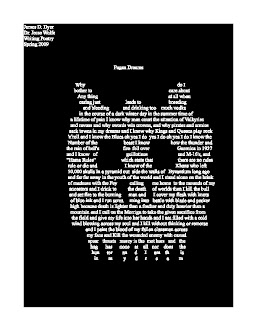
Read more...

Confessions of a Word Junkie: Or, I want to be a writer when I grow up.

 I was pulled screaming into this life on June 7, 1968, at Burbank Community Hospital in the Los Angeles Basin. Less than twenty-four hours earlier, Robert Kennedy died in the same hospital of wounds inflicted by the assassin Sirhan Sirhan, and with him died the chance of a second Kennedy Presidency. My Mother was the only woman in the maternity ward that night. I was the only infant in the nursery, and both of us were alone. Fathers were not allowed in the hospital outside of visiting hours, and the staff was rather preoccupied with the recent assassination, as was much of the rest of the country.

            That aloneness became characteristic of me as a child, and books became my companions and my vice. After reading Sherman Alexies essay Superman and Meyesterday, I took to reflecting on my own literary history and concluded that while our lives were different in all the obvious ways, Alexie and I have much in common. Unlike Alexie with his Superman comic, I do not remember how or when I learned to read. To the best of my recollection, I came out of the womb with the ability and was reading the signs on the wall in the delivery room as soon as my eyes were swabbed clear of the placental gunk blocking my vision. EMERGENCY EXIT ->->. Employees Must Wash Hands! No Visitors After 11pm! Fathers and other relatives must check in at nurses station! No wonder I came to view the world as a cold, hard place. It was those signs.

            I cannot say I have heritage in common with Alexie either. Though family legend says that one of my ancestors on my mothers side brought a Cherokee wife home to East Texas after serving in the Calvary sometime during the 1800s, I am mostly Irish and French as best I can figure out.

            I went to school in Santa Barbara, California, not on a reservation, but my experience in school was nonetheless much like Alexies. In my experience, smart kids in general are feared and ridiculed, not only smart Indians. By the time I started school, I was reading way above grade level, having finished all of Dr. Seuss and Curious George, read Where the Wild Things Are, and moved on to books with more text than pictures. By the end of second grade, I read every Hardy Boys detective novel. In third grade, I went on to read every Nancy Drew mystery. Before the end of fourth grade, I consumed every piece of fiction in the Roosevelt Elementary School library and begun on the Santa Barbara Public Library.

            Like Alexie, I fought with my classmates often. Not daily perhaps but very often. There was always someone wanting to beat up this little geek in Sears and Roebuck Toughskins who never went anywhere without a book. This little geek was from a family of carpenters and firemen, so I was taught from the earliest age that one could never back down from a fight. I got beat up often, and sometimes I won. The fights never really stopped, but most of the bullies eventually got tired of the game because I got better, and even if I lost, they got hurt winning.

            I was smart. I was arrogant. I was lucky. I read books late into the night, until I could barely keep my eyes open. I read books at recess, then during lunch, and in the few minutes left after I had finished my classroom assignments (Alexie. p. 5). I could have written those words. For all of our differences, his story is my story in a way. I read like a fiend. I moved on to adult novels before I hit fifth grade, by way of Science Fiction (Jerry Pournelle, Robert A. Heinlein, Larry Niven, Phillip K. Dick, and Alan Dean Foster) and historical novels (John Jakes, James Clavell). I was always in advanced classes and always in trouble. I read The Bastard, The Rebels (Jakes), Shogun, Tai Pan, and Nobel House (Clavell). I read Citizen of the Galaxy, Have Space Suit Will Travel, Stranger in a Strange Land (Heinlein). I read of John Christian Falkenburg and Lazarus Long. I read Machiavelli, Aleister Crowley, Nietzsche, Jim Morrison, Edmund Burke, Edward Abbey and Henry David Thoreau by the time I was fifteen. When I ran away from home, inspired by those great outdoorsmen, I hitch-hiked into the High Sierra to live off the land (for two weeks until I was caught in an early blizzard) instead of going to the city.

            I started writing stories on my own in about the second grade, poetry in the sixth, and I did four years of English in two years of high school by taking creative writing classes in addition to required courses before dropping out. I took the California Proficiency Exam and lay on the beach reading, writing, and dreaming. Having no religion and feeling the lack, I read The Bible, The Koran, The Bhagavad-Gita, Anton Levey, and Robert Anton Wilson. I read of mystics and demons in The Necronomicon,the Book of Shadows, and everything of H.P. Lovecrafts.

            I read of chivalry and the glories of war, and when I enlisted at seventeen, I insisted on a place in the Airborne Infantry where I found little glory and much ignorance and drunkenness. I carried a hardcover novel and a notebook in the cargo pockets of my BDUs on jungle maneuvers in Panama in 1986. I read Louis Lamour in county jails, and I read Edgar Allen Poe in coffeehouses. I moved all over the country, got married, had a child, destroyed my marriage by drinking like Hemmingway, and continued to feed my literary addiction at both ends--creation and consumption.

            Alexie knew from early on that he was reading to save his life. It was never that clear to me. I just knew I couldnt stop; however, reading (and writing) saved my life. When my problems started affecting my ability to understand what I read and my ability to write coherent paragraphs, as well as threatening my relationship with my son, I straightened my life out. I gave up working in restaurants to become a substance abuse counselor and a college student. I quit working as a counselor when I moved to Turlock to finish my bachelors degree at CSU Stanislaus, but I have never quit reading and writing. I have published a couple of articles on youth culture and amphetamines, and I tutor writing as well as continuing to read voraciously.

            Now my son lives with me full time, and he reads as much as I did at fourteen. I am in a healthy and happy relationship with an English graduate student who has a seven-year-old daughter, and we read poetry and play scrabble together in the evenings. I am a senior now, at thirty-seven, and applying to PhD programs in Sociology; but my passion is still the language. The communication and connection on the page and in the soul of writer and reader. I still want to be a writer when I grow up, and the only thing that stopped me from majoring in English as an undergraduate was a piece of advice in Stephen Kings On Writing where he suggests that aspiring writers should get a college degree in something other than English, as that will give them something to write about. Sociology certainly did that for me because I am fascinated by the way people interact and influence one another. Now I want to turn my attention to the study of writing and teaching writing. I am still smart and lucky, though less arrogant than I once was,

and so I continue--Just another word junkie.

This was three years ago, but I still like it, and I am still with the same woman--which is a record for me, except for my son's mom, and I am still a word Junkie.

Peace.

Read more...

Followers

  © Blogger templates The Professional Template by Ourblogtemplates.com 2008

Back to TOP